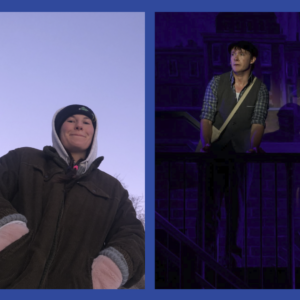
The goods. (Bec Rapacz)
By Jade Enos and Bec Rapacz
Ever seen “Silver Linings Playbook,” the 2012 dramedy with Jennifer Lawrence, Bradley Cooper, and Robert DeNiro? Not only is it a magnetic film with passionate performances and razor-sharp humor, it’s also an intimate look into the lives of complicated people with emotional disorders.
Hollywood often gets mental illness wrong. It didn’t here.
The film’s protagonist, Pat Solitano, has bipolar disorder. What Bradley Cooper does with the character is a gift to the entertainment world, but more exclusively for the people he is representing. It is a relief to be seen, and even more to be understood.
The following conversation, edited for brevity, follows our thoughts and feelings on the realities of living with bipolar. It was preceded by stories of our various manic escapades and hysterical fits of the gigs.
Bec: What do you think is the public perception of bipolar?
Jade: I see videos online all the time. “This weather is so bipolar” or “One minute I’m happy, one minute I’m sad. I’m so bipolar!” That’s not even the tip of the iceberg. It’s so much more than that. People get surprised when I tell them, when I’m manic, I get so angry, I feel I might explode. The rage is something else.
B: Yes! I tried to explain it like this to my mom: I feel like, me, Bec, I’m a normal person. But in my head, I’ve got this big wild animal in a cage, and sometimes it’s pretty well behaved. Sometimes I just throw it a piece of steak and it’s totally happy. But other times it gets up and starts pacing around its cage, and then it starts howling at the gate, and then it’s pounding and clawing at the gate. It’s so distracting. I’m trying to deal with all the pressures and responsibilities of daily life, and I’ve got this beast in my head keeping me from focusing on anything. And sometimes it gets out of its cage, and it feels like a state of emergency. I don’t know what to do about it. I don’t know how to calm it down. I don’t know how to get it back in the cage. It totally takes over and ruins things. I’ve ruined relationships and friendships because my wild animal got out of the cage, so to speak.
J: You explained that perfectly. That’s how it feels. I get vindictive. “Oh, you wronged me? I’m going to wrong you 10 times worse. Your family is cursed.”
B: (Laughs.) I think the perception of it just being mood swings is off base. Yeah, it’s mood swings, but it’s not just flip-flopping. It’s jumping out of a plane. And other times it’s being shot out of a cannon. It’s not just like “I’m happy, I’m sad, I’m happy, I’m sad.” It’s like “I feel so good, I’m gonna run a marathon and learn a new language. I believe in magic.” And then a week later, it’s like, “I haven’t eaten in two days, my friends hate me, and I hope I don’t wake up in the morning.” There’s rarely a happy medium. Do you feel like there is a happy medium?
J: Well, do you have type one or type two? I have type two. I feel like the mood swings are way more intense when I’m in stressful situations. But, if I’m not stressed at all, it’s manageable.
B: That makes sense. Manageable, but irritating.
J: Exactly. I’ve had to quit two jobs because of it. One of them was a dry cleaner, and the other one was food service. They were so stressful. I couldn’t do it. I had to quit. So, stress is one of the things that sets it off.
B: I relate to that. I’ve left a few jobs I’ve had because of my bipolar getting out of hand. Either the workplace wouldn’t allow me to take time off for hospitalization, or I would just snap and not be able to take it anymore. I hate when people say, “Just take a deep breath” or “You just have to stay positive.” Like, you need to understand that when I’m having an episode or a rage fit, there is a chemical imbalance in my brain that keeps me from doing that. I have no ability to think about things positively or even logically right now. My amygdala is being flooded with way more dopamine than it can handle, so all I can focus on right now is smashing my hand into this wall. I’m in fight-or-flight.
J: Exactly. It’s a physical reaction. Yeah. I feel it right in my throat. I need to scream right then or I’ll explode.
B: How about representation?
J: When I was first diagnosed, I looked up bipolar celebrities just to see if there was like, a song I could relate to or something. And the first person who showed up was Kanye West. And he’s out here praising Hitler and saying “Slavery was a choice.” I was like, “God, are you kidding me?”
B: Yikes. He recently released a statement apologizing for all of the stuff that he said, obviously bringing up bipolar and essentially saying “This is all because I was manic; I lost touch with reality.” On one hand, I completely relate to that, the idea that, “I don’t even know myself sometimes. I become a different person.” But then, on the other hand, dude, you can’t just use it as a crutch, you need to atone for the offensive things that you’ve said. You can’t say that slavery was a choice, or glorify Hitler, and then say, “Oh, sorry, I was manic.” You have to do the upkeep, take your meds, see your doctor, take responsibility, because otherwise you’re just an asshole. Like, where’s his team? Who is looking out for him? Who’s making sure he’s taking his meds? He should fire his PR team.
J: Exactly. Another good example of representation is Ian Gallagher from “Shameless.” Did you see “Degrassi”? Craig Manning, he showed up in season two. His character was pretty accurate.
B: I remember “Degrassi”! Let’s see, “Girl, Interrupted” is iconic. I love Angie so much. Anne Hathaway’s character in “Modern Love” was devastatingly accurate to me; the diner scene is a gut-punch. There was another good one with Mark Ruffalo. I can’t remember the name of it, but that one was cute.
J: “Infinitely Polar Bear.” Yeah, that’s on my watch list.
B: Yes! He did a great job capturing the behavior. He’s so lovable, and he doesn’t mean to do any harm, but as a viewer, you’re saying, “Dude, get your shit together.” Which I say to myself on a daily basis.
J: Speaking of movies, I forgot about this. 2023. Another rough year for me. I made it a mission to watch one movie a day for the entire year. I would literally not sleep for days at a time because I would need to have these movies ready to log. I would stay up all night, watch 10 movies in one sitting. I lost sleep over it. But I did it!
B: Insane! Mania, man. When you’re in it, you’re like, “I’m so inspired and motivated, I’m gonna watch 10 movies in one sitting. Locked in.” I love that. People looking at you are saying, “You have bags under your eyes, you haven’t slept in days. Are you eating? When was the last time that you drank water?” But when it’s happening to you, you’re jacked up. You feel like you can do anything, which is a great feeling. Sucks it’s all delusion, and the crash comes. I’d liken it to a non-bipolar person taking Adderall.
J: I wasn’t on a mood stabilizer when I took Adderall, so I remember looking like that picture of the guy from “It’s Always Sunny…” The Charlie Conspiracy meme. That was me.
B: (Shriek-laughs.) Yes! Same thing happened to me when I took Concerta for ADHD; I was a freak. Totally unhinged, fully delusional. Fun fact: People with mood disorders shouldn’t take “legal speed” without a hefty dose of mood stabilizer. Not safe.
J: Can you do caffeine? I drink a Red Bull every day. I can’t get off caffeine.
B: I tried to go without caffeine, but I turned into a bitch. I just keep it to a minimum. I cut out alcohol a few years ago; it messed with my meds and exacerbated my depression symptoms. But I can’t quit caffeine. I need it to work out. I’ve found that one of the best things that I can do for my mental health is really rigorous exercise. I wake up at 5, pound a double shot of espresso, and then go to the gym for two hours. That’s one thing that helps. It zaps all my bad energy.
J: I used to go to the gym, and that definitely helped me a lot. Right now, structure and routine help me. I started going back to school in 2025, and I feel like that has given me more structure, which keeps me on track. Last summer, I was a mess. I was working a job I hated, and I didn’t have a routine. I was going insane.
B: That’s a great point; routine is so important. And obviously there is the act of reaching out for clinical help. But that’s when, in my opinion, things start to get hard. Finding the right therapist these days is so difficult because they’re so understaffed and overworked. It’s hard finding someone that I trust, who takes my insurance, and has the time to see me as often as I need. Or when I’m neck-deep in an episode and have to start the acclimation process for new meds, which may not even work. And if they don’t work, they’re probably going to make me feel way worse than I did to begin with. That’s something that I don’t think many people know. That’s a public perception issue where people think you just have to go to the doctor’s office and tell them your symptoms and they’ll give you meds and they’ll make you feel better. That’s not how it works.
J: It’s never that easy. When I got diagnosed the doctors said, “We’re not gonna put you on anything until it gets ‘bad.’” And then it got bad, and I had to walk down to the doctor’s office and be like, “Hey. Do something.”
B: I’m sorry that happened. My doctor always says, “You have to be a squeaky wheel. Otherwise, you won’t be paid attention to.” Sometimes you need to call the office multiple times a day and ask “Has the doctor gotten my message yet? When will they be available? No, I’m not willing to wait an extra week for my next appointment. Where’s the pharmacy at with my meds?” It’s just the constant self-advocacy, which is something that I struggle with. It’s hard to do, period, but way more so when you’re in the trenches.
J: What would you say to someone reading this who has either been recently diagnosed or suspects they might have it?
B: Welcome to the club, baby! It’s not all bad. I think bipolar people have a great capacity for depth, creativity, and emotion, and that’s something to be proud of. Just be safe. We should start a support group on campus or something. Let’s all play bridge together. What about you?
J: I would say that it’s important to advocate for yourself when it comes to your treatment because if they tell you “We won’t do any additional help until it gets bad,” that is not going to end very well.
B: Agreed. Take care of yourselves, y’all.
According to “Manic-Depressive Illness: Bipolar Disorders and Recurrent Depression, Volume 2” by psychologists Frederick K. Goodwin and Kay Redfield Jamison, bipolar disorder has one of the highest rates of suicide across the mental illness board. Roughly four percent to 19 percent of people struggling with bipolar disorder take their own life. Twenty percent to 56 percent attempt suicide at least once in their life. The fluxes in these percentages have to do with differences in age, gender, financial security, drug use, and many more personal details.
Massachusetts Behavioral Health Help Line: 833-773-2445 (call or text).
988 is the National Suicide and Crisis Hotline, available 24/7.
TalkCampus is a a national online community for students struggling with mental or emotional difficulties. You can connect with people who are fighting the same fight as you, anonymously.
The 4Cs Wellness Center website has multiple links to other mental health resources, including appointment scheduling for student counseling. They can be contacted at 774-330-4857 or at [email protected], and their office hours are 8:30-4:30 Monday-Friday.
We’d like to shout out our cohort on the newspaper staff, Kersten Marchese, who has written a couple excellent pieces on life with autism. Shining a light on mental and emotional disabilities is important work, for the less stigmatized these issues become, the more access the public will have to information on diagnosis, treatment, or how to support.