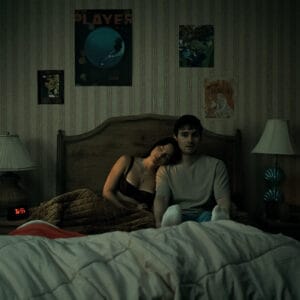
Scene from “The Long Walk.” (Lionsgate)
By Kersten Marchese
What’s your favorite horror movie? I’ll go first: “The Long Walk,” directed by Francis Lawrence. Peter McVries finishes the walk to crowds singing “America the Beautiful” and fireworks exploding overhead as he stares at his dead “brother” and collapses in tears. The public ignores his trauma and grief, sweeping it aside in favor of spectacle.
That scene symbolizes how the United States treats its veterans. Boys in this country are taught from an early age to be tough, calculated, ambitious and strong. They are told it is an honor to fight and die for their country, encouraged to become chess pieces in political conflicts. Innocents kill innocents, fighting people they have never met over disputes they do not control. The film’s horror lies in how normalized this violence becomes.
“The Long Walk” is adapted from Stephen King’s novel. In the story, 100 boys volunteer for a televised competition: a walk with no finish line and only one survivor. The winner is promised unimaginable riches and a single wish. The boys volunteer because they are financially desperate, a reflection of real-world military recruitment in underprivileged communities. Recruiters visit many schools, but they often focus on students who lack financial options, because desperation makes extreme choices seem reasonable.
One of the film’s most disturbing parallels to history appears in the character Curley, who claims to be 18 but is clearly much younger. His deception mirrors boys who lied about their ages to fight in World War I. In Britain, women gave white feathers to men not in uniform as symbols of cowardice, pushing underage boys to enlist. Child soldiers remain a reality in parts of the world today.
Gary Barkovitch is the film’s most tragic character, a personification of post-traumatic stress disorder. He struggles to connect with others, antagonizes Rank and indirectly contributes to Rank’s death. He immediately turns his anger inward, revealing deep psychological damage. As the story progresses, Barkovitch relives the moment repeatedly and blames himself, echoing the guilt many veterans carry. Eventually, he takes his own life in front of the remaining boys, one of the film’s most painful scenes.
The walk itself mirrors war and its aftermath. For many veterans, returning home does not end the conflict. The trauma continues. The walk never really ends.
What makes a film truly anti-war? It shows the reality of war and its aftermath on those who experience it. “The Long Walk” does exactly that, making it one of the most effective anti-war films in recent memory.
“The Long Walk” is available to stream now on Hulu and Apple TV.