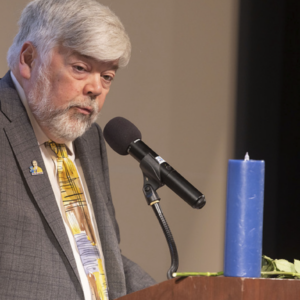
Professor Lisa Heller-Boragine’s “Communicating in Current Settings” class at the Emerson Colonial Theatre (From left) Brianna Kauranen, Pamela Dee, Professor Lisa Heller-Boragine, Attaquis Pocknett-Lopes, and Preston Wright (Bec Rapacz)
By Bec Rapacz
The Suffragists came to Boston! “Suffs” is a Tony-winning Broadway musical about the women’s suffrage movement, written in 2022 by theater actress Shaina Taub. The play is set toward the end of the 70-year movement, around 1913-1920, primarily in Washington D.C. It tells the stories of such great women as Alice Paul, Ida B. Wells, Inez Milholland, and Carrie Chapman Catt. The cast is doing a national tour, and my Communication in Current Settings class was fortunate enough to get tickets to one of the sold-out Boston shows at the gorgeous Emerson Colonial Theatre.
I’m not historically a fan of musicals. And not to sound like Timothee Chalamet, but I never had a strong urge to dig into theater. The only play I’d ever seen was “Jesus Christ Superstar” at the ripe age of six; my mom stopped taking me to church immediately after, presumably because I wouldn’t shut up in Sunday School about how much of a hunk Jesus was.
But at the Emerson Colonial Theatre on March 18, I didn’t feel ostracized or perverted. I felt like a guest in a stranger’s home who’d welcomed me with warmth, exuberance, and transcendent storytelling. The community that gathered in the theater was curious, inspired, and open-minded. Ladies, gentlemen, and others (nods to David Bowie), small children, teenagers, adults, and elders alike buzzed excitedly, speaking with their row neighbors and admiring the beautiful gilded architectural details of the room. Many were wearing Suffragist sashes, a reference to the sashes that the real women wore during protests throughout their multi-generational fight for suffrage. These sashes were sold at the merch table, along with a collection of shirts, tote bags, hats and stickers with memorable lines from the play, my favorite being, “I’m a great, American bitch.”
Waiting for the show to start, I flipped through the playbill. An all-female cast would grace the stage, hammering home the point that this was a story about women that needed to be told, in all authenticity, by women. I watched as Professor Lisa Heller-Boragine immediately became friendly with the strangers next to her, excitedly conversing about how Malala Yousafzai and Hillary Clinton were producers of the show.
As the lights went down, the crowd hooted with excitement. National American Woman’s Suffrage Association (NAWSA) leader Carrie Chapman Catt took the stage and belted out the first number, “Let Mother Vote”, and was met with uproarious applause. The song is a reference to the belief held by many early and elder suffragists that the right to vote would only be won if the faces of the movement were those of distinguished, educated, proper, white women.
The acting and singing were top tier. I had no idea that theater required such athleticism and body control. These women danced, ran, sang, raged, and remembered all their lines for over two and a half hours. Incredible.
If I were to name a complaint about the play, it would be the portrayal of main character Alice Paul. I acknowledge that the Broadway musical version of a character might not be as militant as the original person, but I think that painting Paul as a funny, outgoing, preachy girly-girl is a slight to the absolute dog of a woman that she really was. The real Alice Paul was a force of nature. She was the ultimate irritant to the status quo and authority. She had a quiet, introverted intensity about her that was driven by some unextinguishable fire within. She led hunger strikes in prison and was force-fed raw eggs and milk down a glass tube in her nose or throat, held down by half a dozen people, possibly hundreds of times throughout her life. She was a terror to the proper ladies of NAWSA. She was inexorable. To me, her only demerit was her passive exclusion of Black women from her cause. At the time, it was seen as a liability to link women’s rights with Black rights, so Paul moved forward without the help of her Black peers. I think that’s a shame.
Professor Lisa Heller-Boragine reminds me that, though I was bothered by Paul’s portrayal in the musical, we were watching a creative interpretation. “There were artistic licenses taken that were inaccurate, but this was a piece of art, and ultimately, if this work inspires us to talk with each other about the history and to do our own investigating into the history then it will have done its job.” If one feels like doing their own investigation of suffrage history, Lisa recommends starting with Alice Paul and Ida B. Wells.
Heller-Boragine was a particular fan of the song performed when “the conservative Tennessee state senator Harry T. Burn reads the letter from his mother Phoebe Burn, asking him to vote for suffrage. It’s a true story, and brings home the fact that sometimes it only takes one person to change history, and even if you don’t have the power personally, you may be able to leverage power.” Harry T. Burn’s historic vote for suffrage was the one that broke the tie, allowing for the 19th amendment to be ratified, finally providing American women with the hard-fought right to vote.

The Emerson Colonial Theatre (Bec Rapacz)
We are currently experiencing a bit of deja-vu as a country right now. The Trump administration is pushing the SAVE Act with full steam, and I want to be sure that MainSheet readers know exactly what that means. To quote Lisa, “The SAVE act would mean all married women who have taken their husband’s last name will need to have a valid US passport to vote. Passports cost hundreds of dollars and this bill would make it very difficult for millions of women to vote.” Basically, if your current name doesn’t match the one on your birth certificate or a valid passport, you will be turned away at the polling stations. Non-profit public libraries have been a safe resource for passport services for more than 20 years, but as of Feb. 13, that resource is under attack. Here is more on that.
The Trump Administration says that the act is to protect democracy by keeping undocumented immigrants from voting. Despite the aggression with which they insist this is a huge problem plaguing America, it isn’t.
To quote “Keep Marching”, sang by the ladies of “Suffs:” “We did not end in justice, and neither will you…Your ancestors are all the proof you need that progress is possible, not guaranteed.”
“Suffs” not only gave me a reason to make sure I and all my female friends are properly registered to vote, but it also gave me a reason to dig into theater. It was a glimpse into the unbelievable amount of time, effort, and passion that people put into art. It was a chance for me to marinate in a new culture, and to learn through creative expression. The importance of theater, and that shared experience of entertainment and joy, was written all over the faces of those in attendance. The soft sniffles of viewers wrapped up in emotion, the hoots and hollers of jubilance or anger, and the screams or tears shed during the final standing ovation were all testaments to the enduring staying power of this magnificent art form. I am so grateful to have been there.
And finally, I am grateful to the women that laid their lives on the line for the past 176 years to make sure that I have the right to cast a vote. I will not take them for granted.
Susan B. Anthony crawled, so that Alice Paul could walk, so that Angela Davis could run, so that we can fight.