Aid dropoff in remote village near front lines, Dec. 2025. (Lisa Mure)
By Bec Rapacz
We’re living in trying times. In between work, schoolwork, shoveling our neighbors out, protesting, or caring for our families, we are plagued by the news. Be it international, American, or local, it’s been hard on the psyche to stay informed.
I ask myself constantly, “What can one person really do to make change?”. The answer is: a whole lot, babe. Write to my senators. Go to protests. Post and repost online. Donate to local and international charities. And now, another option has been presented: I can knit.
A grassroots organization called “Common Man for Ukraine” has called on knitters across the country to raise their needles in resistance and get to work to aid in convoys to Ukraine. Russia is targeting Ukrainian power centers, so millions of people are currently without heat, electricity, or running water for up to days at a time. As temperatures drop into single and subzero digits, the need for warm clothing has never been stronger.
Common Man has answered Ukraine’s plea, and mobilized people in New Hampshire have successfully raised the funds to send food, solar lanterns, and hand-knitted items like hats, mittens, socks, blankets, and children’s toys. Their 15th convoy will leave for Ukraine in early March. On top of donating supplies, Common Man also works closely with a retreat just across the border in Poland, where orphaned children (and more recently, widows) of fallen soldiers can go for trauma counseling, socialization, and a much-needed break from air-raid sirens and the threat of being bombed.
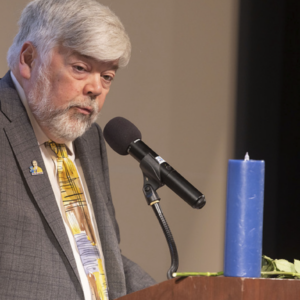
One of Common Man’s founders, Lisa Mure, made time to answer some questions and has offered to come to our campus to give a presentation on her organization’s work. Meanwhile, what can a student or group do to contribute to Common Man for Ukraine?
The interview below was edited for brevity and clarity.

Aid dropoff in remote village near front lines, Dec. 2025. (Lisa Mure)
Q: What are the items that are needed on the ground in Ukraine right now? I’ve been told about knitted items like socks and mittens, but what other necessities should the Cape Cod community look forward to donating? Would a used clothing drive be helpful on campus, or are you looking primarily for funding to buy clothing, food, etc.?
A: There are many needs on the ground but carrying them over can be costly and slow. Thus what we collect here and take there are items that are an opportunity for Americans to show their love and care in addition to or instead of a donation. Right now, that is hand-knit wool socks and mittens fastened together so they do not get separated in transit. If they are sent to us by the first week of March. We will deliver them in mid-March when we travel there next. The drop-offs near the front are often hurried due to safety issues. We are also collecting unused, tagged regular-sized beanie babies that we distribute to every child we see when we are in Ukraine. The other items needed that we distribute are solar lanterns which we typically get at a discount from one of two companies that we know who reached out to us because of their commitment to helping Ukraine. For the solar lanterns we accept donations on the web site (commonmanforukraine.org) to purchase them in the EU or sometimes here and we bring them. As far as other items, we determine needs each month, such as blankets, sleeping bags, toiletries, etc. and use donor funds to purchase them in the EU to keep delivery costs down. We do not bring clothing and other bulk items because they are available in Eastern Europe without the expense and time lost to shipping.

Memorial wall for fallen soldiers, Dec. 2025. (Lisa Mure)
Q: Going into your 15th trip to Ukraine, have you seen the devastation ramp up every time you go? I imagine that you are trying to assist more people each time, which would only lengthen the to-do list.
A: Yes, every trip reveals a different stage of the war and of humanitarian relief. In the early days it was millions of war refugees crossing the border and needing shelter and support in another country. Many of them have since returned to Ukraine to take their chances and do their best to support their country. Winters mean the need for generators, blankets and solar lanterns because (Russian President Vladimir) Putin bombs the infrastructure to wear down the civilians. Right now it is both winter with the energy grid under attack and a drone war in which many cities are bombed almost nightly. Other needs that are surfacing as the war drags on are related to interrupted schooling. Many children have not had a regular school week for almost four years. We have seen some aid groups invest in underground schools (expensive), but we have not yet determined a way for our project to support the education vacuum happening in Ukraine, particularly for younger children. But we continue to witness the problem and to consider partnerships.
Also, our humanitarian aid convoys have been so helpful to poor villages near the front who are cut off in many ways. They are in danger zones that many aid groups do not want to enter. Many front-line villages are in areas that Russia occupied in 2022 but were pushed back by Ukraine. When Russia retreats, they shoot up, bomb, and mine whatever they can. So, homes in these areas are completely or partially destroyed, the farmland is mined so the villagers cannot work the fields, and the buildings to process the food grown in an area are also destroyed. This means the people still living there – the elderly, young families, and the poor – have very little ability to access food and other basic supplies. We have van convoys that go to these areas regularly with basic food staples, blankets, solar lanterns, etc. We’ve delivered over 4 million pounds of food and thousands of items to keep them warm and to bring light when they go for so long without power.

Children’s retreat, Zakopane, Poland, Dec. 2025. (Lisa Mure)
Q: I am floored by the bravery and optimism of the kids that I see on your website. What a cool idea to run a mental health retreat and offer trauma counseling. Did you run into any bureaucratic issues in the process of setting this up? And could you tell me a little bit about where these kids are coming from/what they are hiding from? A video on the website said that they were hiding out in abandoned schools, safehouses, and repurposed monasteries. I was not aware that kidnapping had become yet another problem that they needed to fear.
A: Yes, the children are the ultimate victims of this unjust and unprovoked invasion of a sovereign country. They are losing their parents, they are at risk of being abducted by Russians, and they are often sent by families away from areas under heavy attack to safe houses in other parts of Ukraine. To support these children whose families may not be able to leave their homes but who want to protect their children, Ukraine has set up a safehouse system that comes in many shapes and sizes. The government uses empty decommissioned buildings – e.g. old military barracks, old dormitories, etc. – which they clean up and staff; they also put children needing a safe place into temporary housing on the grounds of existing schools, they add these internally displaced children to the rosters of orphanages to wait out the war, and they even ask families in safer areas to take in children from higher risk areas into their homes. Thus safehouses come in many different shapes, sizes and types.
For the children who come to our retreats, the Ukrainian military identifies families of lost soldiers who have children between the ages of 8 and 12 years old. They refer the families to our partner organization in Poland and a pediatrician in Lviv who contact the families from all over Ukraine, they tell the families about the retreat opportunity, and children are signed up for an upcoming retreat date. The retreats happen every month and, including travel to and from Lviv, last about three weeks. Each retreat month has a new group of about 35 children from all over Ukraine who meet at the train station in Lviv on the first day; they meet the Ukrainian counselors and other children attending the retreat for the first time. They hug their mothers and other family farewell and get onto a bus that takes them across the border to Poland… During the retreat they do many activities including art, music, small group sharing and other activities that are specifically designed to help them process their grief, to talk about their worries, and to build skills to help them recognize anxiety symptoms and to practice self-calming techniques and when to ask for help, etc… They fill out a survey at the end of the retreat and we have listening sessions with the mothers about the impact of the retreat on their children. The feedback is overwhelmingly positive and mothers have told us – unsolicited! – that their child returned home wanting to talk about their father for the first time, newly optimistic about their future, wanting to help around the house, and in general as if a light returned to them…The feedback from mothers was so positive that they asked if they, too, could have a retreat… So we listened, we asked donors to help out, and now there is a widows retreat every month in the same village in Poland.
There are many bureaucratic hoops to clear, and they are important ones. Ukraine wants to be certain that their children will be safe, there is much paperwork and passports to gather from each family to facilitate the border crossing and so forth. But because the Rotary group already had partners in the Ukrainian government and military from their retreats in previous years, it made the program expansion fairly smooth. We also rely heavily on a pediatrician in Lviv who contacts families and makes sure all health and medical issues are addressed before, during and after the retreats. We are so grateful to her and the counselors she identifies to staff the retreats each month… The retreats have now served almost 1500 children!
Q: For students, money is often tight. What assistance can a school community offer to your and other organizations without donating money?
A: Other than hand-knit wool socks, funding is really the most impactful. But people can and have done fun, simple things to raise funds to help. People have raised money for Common Man for Ukraine by hosting corn hole toss contests, ukulele concerts, tennis tournaments, coffee sales, social media reels/posts, etc… Other than that, there is plenty we don’t think of so brainstorm away. We are happy to help think through ideas to help Ukraine. We try to just say yes whenever we can…the children of Ukraine are so worthy!