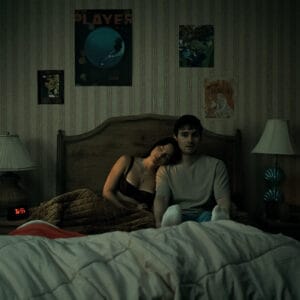
4Cs artist Sophia Capobianco’s creative visual interpretation of Yebba’s new album. (Sophia Capobianco)
By Bec Rapacz
There’s something so resolutely and willfully human about pared down, minimal production these days. Close mics. Audible voice cracks. Whispered harmonies. String noise. Percussion that consists of foot stomps, hand claps, snapping, well-timed breaths, and the choppy strums of an acoustic. We live in a musical age where artists really don’t have a ceiling in terms of what they can make their music sound like, so for a Grammy-winning musician to make an album that sounds like it was recorded sitting around a campfire, that’s a statement. It says, “I’m human. Cut me open and see me bleed.”
“Jean,” Yebba’s second full-length album and tribute to her late grandmother, is the phoenix that rises from her debut, “Dawn,” which for all intents and purposes was Yebba’s act of emotional bloodletting. “Dawn” was the storm; “Jean” is the dew in the air that follows it. “Dawn” was the grieving process that followed a traumatic death, and “Jean” is the diamond unearthed after years of pensive self-exploration. It’s the act of stepping forward and declaring “It hurts, but I’m here.”
Compare it to fellow vocal powerhouse Raye’s recent singles “Where is My Husband!” and “Nightingale Lane.” Both songs are breathtaking in their respective productions and constructions. The presence of full orchestra, choir, and Raye’s earth-shattering vocals create dimension, glamour, and excitement in the same way that cocktails, a white line, and a well-rolled spliff do. Add enough stimulants, and a listener won’t be able to tell if what they’re listening to is sensational or subpar. What mimics grandeur can quickly become camp. One could say that overproduction is just a distraction, in some cases. (I am throwing ZERO shade at Raye, she is often an example of drama done right, and if “Nightingale Lane” isn’t nominated for something then I will riot.)
Yebba’s “Jean” is less like a night out and more like the morning after. No hair of the dog; she sits with the discomfort of a hangover. There are no appearances being held here; the album emotes complete transparency and surrender, a true confession of “I have nothing to prove.”
And Yebba certainly doesn’t. On past work, be it songs from her debut album-a hauntingly intimate tribute to her late mother-or her features on seismically popular artists’ songs (she is a repeat collaborator with Drake, Tyler the Creator, and Lucky Daye, and was handpicked by Q-Tip to sing on A Tribe Called Quest’s final album), Yebba’s otherworldly vocals are practically on a pedestal. Untouchable. She’s a chunky white girl from the Midwest rivaling the voice control and diaphragm of Whitney and Aretha at their peak. Legendary soul singer and back-up vocalist Merry Clayton once said that real singers learned to sing in church as a kid, and Yebba is the enduring proof of that statement. Gospel music enters your bloodstream and never escapes it.
On the garage-rock-esque “Aggressive,” we get to hear her technically trained operatic pipes come out to play. On “Of Course,” our girl has some fun and flirts with herself over Nate Smith’s warp-speed jazz drums. On “West Memphis,” she asks “what’s realer than the part of you that you don’t even claim?” She grapples with the “country” identity and its roots during a visit to her hometown in Arkansas. “Battleship and a Ouija board, who could ever ask for more? Formula from the corner store, they had no idea they grew up poor. It was TBN and Praise the Lord, then Powerball was on by 4… It ain’t the booze, it ain’t the bars… It’s a well that’s dug down deep inside of you.”
The standout to me is “Yellow Eyes,” the only single on “Jean.” The restrained vocals float light as a feather over a tender acoustic riff with an eerie background track that conjures up a feeling of the wind picking up before a storm. As you turn the words over they taste like survivor’s guilt, with the distinct flavor of nostalgia, perhaps a sprinkle of repressed rage. The combination makes for a well-rounded palette of grief. The aura begins foreboding. “Temperature change, green in the sky. Sailor‘s warning and a black butterfly waiting on me.” Yebba knows something bad is coming; a possible allusion to the 2016 suicide of her mother. “Unfurnished, it felt like a home. Think I’m jealous about movin’ on. I still like it the way that it was, so make up the bed on the floor.” She sees the past as a place to escape from, though she keeps pieces of it close like tresses of hair in a locket. Memories have a way of never quite releasing you from the past, though they may dull the sting by softening or sweetening over time. You’re allowed to long for past comforts, even if they were born from the same place as past traumas. Reflection is complicated.