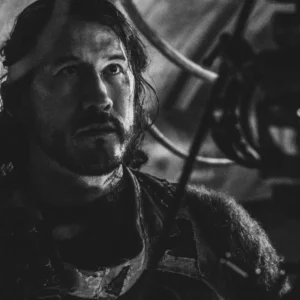
Cooper Hoffman, left, and David Jonsson appear in “The Long Walk. (Murray Close/Lionsgate)
By Isabella Cantillano-Sanchez
“The Long Walk,” the highly anticipated adaptation of Stephen King’s 1979 novel of the same name, showcases uncomfortable truths about humanity with a starkness rarely seen in mainstream films. Director Francis Lawrence, best known for his “Hunger Games” films, is no stranger to dystopian societies or doomed young adults. Unlike his “Hunger Games” entries, “The Long Walk” is stripped of a glossy veneer in favor of true bleakness. The brutal violence is intercut with moments of camaraderie that reverberate more strongly than the gunfire.
The film follows Ray Garraty (Cooper Hoffman) as he embarks on The Long Walk alongside forty-nine other young men. This annual event, supported by the totalitarian military regime that now rules the United States, consists of these boys maintaining a pace of three miles per hour until only one of them remains. Falling below that speed earns them a warning from the soldiers, who are following their every move. Three warnings and they get their “ticket.” The leader of this regime, “The Major” (Mark Hamill), appears throughout to motivate the participants. These participants include Peter McVries (David Jonsson), Arthur “Art” Baker (Tut Nyuot), Hank Olson (Ben Wang), Collie Parker (Joshua Odjick), Gary Barkovitch (Charlie Plummer), Richard Harkness (Jordan Gonzalez), and Billy Stebbins (Garrett Wareing). The walkers form intense relationships with each other, leading to unexpected consequences.
The cast of this film is the most impressive young ensemble in recent memory. Hoffman carries the film with an easy humanity evocative of his late father Philip Seymour Hoffman, bristling with anger at the system while still brimming with vulnerability. Jonsson, who arguably shares the film with Hoffman, gives a star-making performance infused with warmth. Other standouts include Nyuot, Odjick, and Plummer, whose performances run the gamut of gentle, fierce, and fractured.
Despite tonal differences, “The Long Walk” feels like a spiritual successor to “Stand by Me” in that it explores masculinity with nuance and sensitivity. It is a dark coming-of-age tale that emphasizes the importance of young men remaining empathetic and daring to love, especially in a society that seems to only reward the opposite.