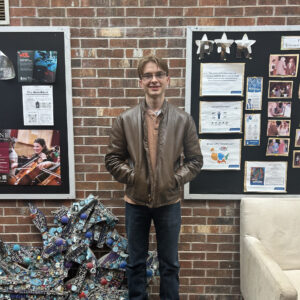
Professor Ralph Negron, middle, appears with The MainSheet staffers Bruce Bowen and Sophia Roscoe at the WKKL studio. (Sarah Davenport)
By Bruce Bowen and Sophia Roscoe
With Veterans Day – Tuesday, Nov. 11 – around the corner, 4Cs Professor Ralph Negron, a retired Marine colonel and Vietnam veteran, sat down to discuss his service and thoughts.
Q: Can you tell us about your military service?
A: I was born into it because my dad was a career soldier, so I was born on an Army post and throughout my entire life that’s all I ever wanted to be was a soldier. When I went off to college, I had a roommate who had been a corporal in the Marine Corps, and I thought, ‘Boy I tell you if you’re going to be a soldier, let’s be a Marine.’ When I graduated from college I was commissioned as second lieutenant in the Marine Corps. I started off in tanks. I went to tank school, but when I got to Vietnam, I went to an infantry unit, and I never saw a tank the whole time. I stayed in for over 20 years. I was a career Marine, and then I retired upon the wishes of my wife, who was sick and tired of all the traveling that we were doing. There was a point I had orders to Hawaii, and I was going to be in the first Marine brigade in Hawaii and she lifted her hands and said, ‘I’m done; I’m not moving anywhere else,’ so I ended my career.
Q: Do you think the meaning of Veterans Day has changed over time?
A: If anything has changed, remarkably, it’s Veterans Day. I could say that when I was a kid, everybody’s father was a veteran. More than 50 percent of the American population were veterans, and that includes women. You know, that’s a sizable chunk of the population. Today, somewhere between 5 percent and 7 percent of the population is our veterans, and that’s because today less than 1 percent of our population is in the military and that includes National Guard and Reserves. … People don’t understand what the military is all about, and I’ll tell you what: Although I appreciate people thanking me for my service, I hate that phrase. It’s so empty because most people don’t understand. They have no idea what military service is all about; so when you thank me for my service. … it seems very casual to me.
Q: If you could share one message with the campus community this Veterans Day, what would it be?
A: I think that one of the things that is important to me as I reflect on my own service is that military service isn’t a job, it’s a commitment, and every time I got promoted and when I got sworn in, you swear that you’re going to defend the Constitution of the United States. It’s important to understand that what’s in the Constitution is what you are defending. I think that if there’s anything I would leave I think it’s important that veterans look at the Constitution. … I think that veterans have a very special perspective about things. You learn a lot about organization, about mission, about discipline, about courage. You attain a lot of important virtues as a veteran, and I think it’s important that all veterans apply those in a civic way. Don’t just sit there and watch the world go by. … I think it’s (important) to get out there and let people know what the military is all about.
Q: Is there a particular memory or moment that comes to mind each year on Veterans Day?
A: Yes, I think that on Veterans Day we really focus on the veterans, but there’s also … the families of the veterans who make tremendous contributions and sacrifices. On Veterans Day, I always think about my mom, who as a wife saw her husband go off to World War II and the Korean War. My dad was one of the first advisers in Vietnam. She and my brother took me to the airport and my mother was a nervous wreck. I was excited to be going off to war – I remained excited until somebody started shooting at me, then I realized what I had gotten myself into. When we got to the airport my mother was edgy, when they called out the boarding of our flight she collapsed into a chair and started crying. … I said ‘Mom, what is the matter with you? I’m only going to Vietnam.’ I thought going to Vietnam was no big deal. But I will never forget what she said: ‘First your dad, and now you. When the hell is this ever going to end?’
Q: What role do you think colleges like Cape Cod Community College can play in honoring veterans?
A: I think that 4Cs is very veteran-friendly. President Cox is very pro-veteran. I don’t think that there is anything he wouldn’t do for our veterans. We have a Student Veteran’s Office headed by (retired) Lt. Col. Paula Smith, and she does a really great job. I think it is important for a college to recognize that it is a huge transition that you make when you go from military to civilian life, especially to a college. It’s a really tough transition, you’re leaving a very tightly knit little group where it’s very familial in the military units you are in – especially the combat units – and all of a sudden you are on campus and you have all of this freedom, and that’s a tough transition. … 4Cs is very attentive about making certain that our veterans understand what their abilities and their benefits are and that they get academic credit for the advanced technical training they received while in our county’s service.
See Professor Negron’s guest column with https://mainsheetcapecod.com/guest-column-veterans-day-and-the-power-of-citizenship-at-4cs/.